
Guide · Make It Happen
Construction Methodology & The Build Spectrum
A Retrofit Strategy can be built in more than one way. The same road diet can appear overnight as cones and paint, or arrive years later as full curb-to-curb reconstruction. Neither is more legitimate than the other. This page locks CS's position on how these approaches relate, when each is appropriate, and why the choice matters as much as the design itself.
This page sits alongside How Road Changes Actually Happen because the build method is as much a part of getting something done as the jurisdictional process is. Knowing who can approve a change matters less if you don't also know what kind of change you can ask for first.
Related Media
 Aligned
A Better Block Versus Years of Planning
 The Strong Towns Podcast
Better Block's Krista Nightengale explains the temporary-build, test-and-adjust method for redesigning streets instead of studying them for years. It mirrors the Commonway System's build spectrum, which favors demonstration and pilot stages before permanent construction.
MED-069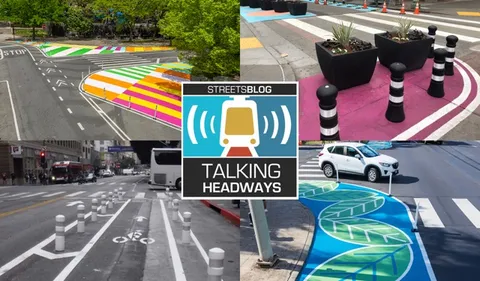 Aligned
Talking Headways Podcast: Lessons from Quick-Build Street Projects
 Talking Headways
Jeff Wood interviews Smart Growth America's Heidi Simon on how local governments and advocates work through state DOT permitting to change streets via quick-build projects. It matches the Commonway System's "how governments process requests" section as a general process discussion rather than one city's project.
MED-088#The four stages
Practitioners in this field, most consistently the Street Plans Collaborative1 and cities like Burlington, Vermont,2 describe a four-stage build spectrum. CS adopts this framing directly, since it's already well-tested in practice and gives a shared vocabulary for talking about how much commitment a given installation represents.3
Demonstration. Hours to about a week. Low-cost, temporary materials: chalk, tape, cones, planters. Often led by residents, a business district, or a nonprofit rather than the public agency itself. The purpose is to show a possibility, not to test performance rigorously.
Pilot. Roughly thirty days. Typically led by the public agency, using slightly more durable temporary materials. The purpose shifts from demonstration to genuine testing, gathering real data on how a design performs before committing further.
Quick-build. One to five years. Semi-permanent materials, durable enough to function as real infrastructure while still being reversible if the design doesn't work. This stage is where most of a project's real-world evidence gets generated, since it lasts long enough for genuine before-and-after comparison.4
Permanent. Full capital construction: concrete, signal equipment, complete reconstruction. The final stage, typically undertaken once a design has been tested and proven, or where the strategy's scale makes anything short of full construction impractical from the outset.5
#CS's position: test before you pour
Where a Retrofit Strategy can move through this spectrum, CS holds that it should. Skipping directly to permanent construction on an unproven design commits money, political capital, and years of construction disruption to a configuration that hasn't been tested against how people actually use the street. A pilot or quick-build stage costs a fraction of that, is reversible if wrong, and produces the evidence a permanent version will need to justify itself anyway.
This isn't a claim that every project must pass through all four stages in sequence. A jurisdiction with strong existing evidence for a given design, or a strategy too small in scope to warrant a formal pilot, can reasonably move faster. The position is narrower than that: skipping the testing stages should be a deliberate choice made with reasons, not a default.
#Not every strategy can move through this spectrum
Some Retrofit Strategies genuinely cannot be piloted with paint and cones. An Intersection-scale strategy involving new median construction, signal relocation, or significant grading, a Median U-Turn retrofit, for instance, requires real construction to exist at all. There's no meaningful demonstration version of moving a signal head.
Each Retrofit Strategy page states plainly, in its Getting it built section, whether it can move through the full spectrum or effectively requires starting at Permanent. This page explains the spectrum itself; it doesn't repeat, strategy by strategy, which stage each one starts at.
#Materials change by stage, not just duration
The distinction between stages isn't only how long an installation lasts. It's also what it's built from. A demonstration uses materials meant to be removed by hand: chalk, tape, delineators. A quick-build uses materials meant to survive years outdoors but still be pulled up if needed: modular curbs, durable paint systems, movable planters. A permanent installation uses materials that assume the design is final: poured concrete, underground conduit, fixed signal infrastructure.
This matters because a design that looks identical at the pilot and permanent stages can represent very different levels of commitment underneath. Reading a strategy's stage tells you not just how new it is, but how easily it could still change.
#References
- Precedent-based Street Plans Collaborative. "Tactical Urbanist's Guide to Materials and Design."(opens in new tab)
- Precedent-based City of Burlington, Vermont. "Quick Build Design + Materials Standards."(opens in new tab)
- Precedent-based Congress for the New Urbanism. "Merging Tactical Urbanism with Public Works."(opens in new tab)
- Evidence-based PeopleForBikes. "Quick Builds for Better Streets: A New Project Delivery Model for U.S. Cities."(opens in new tab)
- Precedent-based Global Designing Cities Initiative. "From Pop-Up to Permanent: Five Lessons in Tactical Urbanism."(opens in new tab)