
Induced Demand
Why wider roads don't fix traffic
In 2008, Texas finished a $2.8 billion rebuild of Houston's Katy Freeway: six through lanes each way, plus toll lanes down the middle. The goal was to end congestion that lasted up to 11 hours a day.1
In its first years, it worked. The evening drive between Taylor Street and Barker-Cypress fell from about 38 minutes to 28.2
Then the new lanes began to fill. Peak-hour travel times rose in the years after opening, and researchers working for the state tied the rise to growing traffic.3 By 2013, the round trip from Pin Oak took 32 minutes longer each day than in 2011.4
The lanes got wider. The gains got smaller. This pattern has a name: induced demand.
#What it is
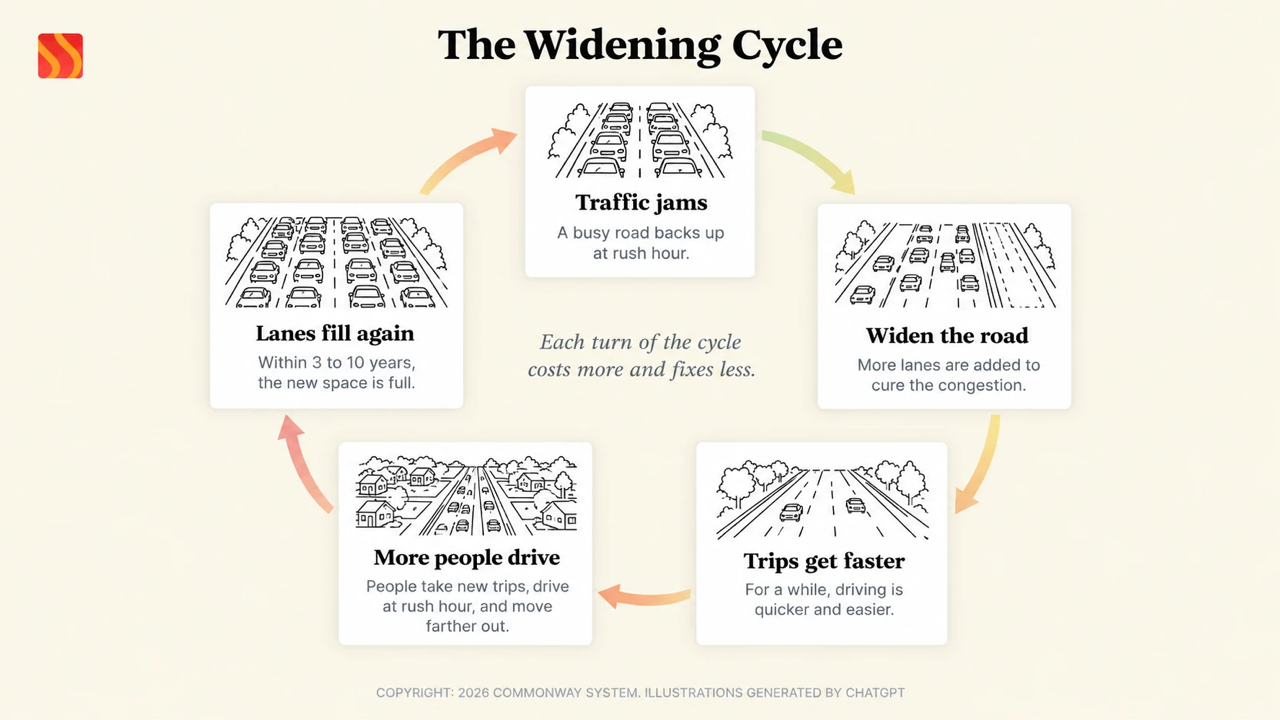
Lanes are free to use, so the real price of driving is time. Add lanes and that price drops. When something gets cheaper, people use more of it. They drive at rush hour instead of before it, take trips they used to skip, and move farther out.5 Within a few years, the new space is full again.
#Why you should care
- Your time. The faster commute a widening promises fades within 3 to 10 years.5
- Your money. One corridor cost $2.8 billion.1 Money spent on lanes that refill is money not spent on fixes that last.
- Your streets. The extra driving spreads across the whole network, not just the new lanes.5
- Your town. Homes and businesses spread outward to follow the road, which locks in longer drives.5
#How it happens
Some of it comes fast. People switch from transit or carpools to driving alone, take longer or more frequent trips, or move trips into the busy hours.5 Some comes slowly. People move farther from work, businesses relocate, and development follows the road.5
A study of 228 US metro areas traced the largest shares of the new traffic to residents driving more and to trucking. People moving into the area and traffic shifted from other roads mattered much less.6
Related Media
4 items
 Aligned(opens in new tab)
More Lanes Are (Still) A Bad Thing
 Not Just Bikes
Separates induced from latent demand, then covers traffic evaporation, Braess's Paradox, and the Dutch one-lane-plus-transit cross-section as the alternative.
MED-008 Aligned(opens in new tab)
More highways, more driving, more emissions: Explaining "induced demand"
 Transportation for America
Explains induced demand with hard numbers: from 1993 to 2017, the 100 largest US urbanized areas added 42 percent more freeway lane-miles while population grew 32 percent and delay rose 144 percent. A clear explainer for the concept at the core of the Commonway System's skepticism of highway expansion.
MED-048 Context only(opens in new tab)
How highways make traffic worse
 Vox
VoxExplains induced demand through the Katy Freeway widening and why transit alone falls short. Its Boston example is mischaracterized: the freeway was buried, not removed.
MED-040 Context only(opens in new tab)
Effectiveness of Ring Roads in Reducing Traffic Congestion in Cities for Long Run: Big Almaty Ring Road Case Study
Sustainability (MDPI)This peer-reviewed study reviews ring-road history and post-opening evaluations worldwide and finds that orbital roads give only temporary congestion relief before induced traffic fills them, while shifting accessibility and development toward the suburbs. It describes the dynamics behind the Commonway System's Beltway / Ring Road pattern: a beltway that diverts through traffic today becomes the congestion corridor of the next ring tomorrow.
MED-119
#How strong is the evidence
Note
On major roads, added capacity typically brings 8 to 10 percent or more driving per 10 percent more capacity within 3 to 10 years, less at first, and less is known for local streets.5
A University of California, Davis review of 12 studies rated this evidence high quality and found the added driving is new, not shifted from other roads.5 The national study's best estimate: 10 percent more interstate lanes brought 10.3 percent more driving.6 Researchers have measured the effect since at least the 1940s.6
#Fair questions
Isn't it just drivers who were already stuck in traffic? Partly. Some trips were held back by congestion. But the added driving is mostly new, not shifted from other roads, and it keeps growing for years as homes and jobs move.65
Won't more transit fix it? Not on its own. The national study found no evidence that added transit service changed total driving, because others fill the freed space.6 Transit still serves its riders well.
So should we never widen a road? No. New capacity can open access to places that were hard to reach before.5 The point is narrower: widening doesn't cure congestion.
Does this apply to my street? The evidence is strongest for highways and major roads. The effect may be smaller at first in rural areas, and less is known about local streets.5
#What works
Price the road. The national study names congestion pricing as the main remaining tool.6 New York began tolling vehicles entering Manhattan's central business district in January 2025. In the first year, 27 million fewer vehicles entered, an 11.7 percent drop, according to the MTA, which runs the program.7
Give road space to other modes. Researchers reviewed more than 70 cases where road space moved from cars to buses, bikes, and walking. In 51 of 62 measured results, traffic fell, with a median drop of about 11 percent of the traffic that had used the treated road or area.8 Results depend on local conditions, and in some cases traffic crept back.8
Seoul tore down a 10-lane road and a 4-lane elevated highway that carried over 170,000 vehicles a day, and restored the stream beneath them. Bus ridership rose 15.1 percent and subway ridership 3.3 percent from 2003 to 2008, and cutting lane capacity cut traffic.9
Count the extra driving first. Before approving a widening, estimate the driving it will add. UC Davis publishes a calculator for this.5
#What the Commonway System does
The guidebook treats added lanes as a cost, not a cure. When a road is congested, it looks first at pricing, at moving road space to buses, bikes, and walking, and at a connected street network that gives trips more than one route. Widening is the last option, and any forecast for it should include the extra driving it will create.5
Arterials. The Arterial Default (ART-DEF-01) keeps through traffic apart from parking and driveways. Boulevard (ART-BLV-02) pairs through lanes with a frontage built for people. Stroad (ART-STD-05) is marked Avoid. One-Way Street (ART-OWS-06) and Parkway (ART-PKY-07) are Situational or Discouraged.
Freeways. The Freeway Default (FRE-DEF-01), Expressway (FRE-EXP-02), and Beltway or Ring Road (FRE-BLT-03) sit outside the guidebook's detailed design scope. This page states the guidebook's position on whether to widen them.
#What you can do
When a widening is proposed near you, ask:
- Does the traffic forecast account for induced travel?
- What will travel times be in ten years, not just on opening day?
- What would pricing, bus lanes, or a better-connected street network deliver for the same money?
See How Road Changes Actually Happen for how to raise these at a public meeting.
#References
- Precedent-based Federal Highway Administration. "Project Profile: Katy Freeway Reconstruction."(opens in new tab)
- Precedent-based ⚠ Freemantle, Tony. "Expanded Katy Freeway Shaves Minutes from Commute." Houston Chronicle, 2012.(opens in new tab) Reports Texas A&M Transportation Institute data; the original TTI study has not yet been located.
- Precedent-based Goodin, Ginger, Robert Benz, Mark Burris, Marcus Brewer, Nick Wood, and Tina Geiselbrecht. Katy Freeway: An Evaluation of a Second-Generation Managed Lanes Project. Report 0-6688-1. Texas A&M Transportation Institute, 2013.(opens in new tab)
- Precedent-based Reyna, Jennifer. "Houston Commute Times Quickly Increasing." KPRC Click2Houston, February 4, 2014.(opens in new tab)
- Evidence-based Volker, Jamey, and Susan Handy. "Increasing Highway Capacity Induces More Auto Travel." Policy brief. National Center for Sustainable Transportation, UC Davis, January 2023.(opens in new tab)
- Evidence-based Duranton, Gilles, and Matthew A. Turner. "The Fundamental Law of Road Congestion: Evidence from US Cities." American Economic Review 101, no. 6 (2011): 2616–52.(opens in new tab)
- Precedent-based MTA Bridges and Tunnels. Key Performance Metrics, January 2026. Metropolitan Transportation Authority, 2026.(opens in new tab)
- Evidence-based Cairns, Sally, Stephen Atkins, and Phil Goodwin. "Disappearing Traffic? The Story So Far." Proceedings of the ICE: Municipal Engineer 151, no. 1 (2002): 13–22.(opens in new tab)
- Precedent-based Global Designing Cities Initiative. "Case Study: Cheonggyecheon; Seoul, Korea." Global Street Design Guide.(opens in new tab)