
Guide · Core Concepts
How the Transportation Ecosystem Fits Together
Which rules your city must follow, and which it can choose to ignore
In 2010, a group of Los Angeles residents with mobility disabilities sued their city over its broken sidewalks, missing curb ramps, and blocked crosswalks.1 They didn't cite a design guide. They cited federal disability law.1
In 2016, a federal court approved the settlement: Los Angeles would spend about $1.37 billion over 30 years making its sidewalks and crosswalks accessible.1 The money pays for curb ramps, repairs to tree-root damage and uneven pavement, and clearing obstructions, with a share set aside for residents' own requests.2
A design guide can recommend a wider, smoother sidewalk. Only a law can make a city build one. This page is about telling the two apart.
#Three kinds of documents
Every document that shapes your street is one of three things:
- Rules that bind. Laws and regulations. If your city is subject to them, following them isn't optional.
- Guidance professionals follow by choice. Manuals and design guides written by engineers and planners. Cities often adopt them, but nothing forces them to.
- Arguments advocates make. Movements and nonprofits building public pressure for a different kind of street. Their power shows up in what voters demand and what gets funded.
The name on the cover won't tell you which is which. AASHTO's Green Book calls itself A Policy on Geometric Design, yet federal regulation makes it the required standard for National Highway System projects.3 NACTO's Urban Street Design Guide comes from an association of cities and transit agencies, and FHWA treats it as one of many sources to inform design, not a requirement.45
#Why you should care
- When the city says no. "The manual won't allow it" is sometimes true. Sometimes the line being cited is only a recommendation, which an engineer may set aside when judgment or study supports it.6
- At a public meeting. Citing a binding rule asks the city to comply. Citing guidance asks it to choose. Both can work, but they are different requests.
- When you read a pattern. Every reference in the Commonway System carries a tier chip: Legal / regulatory, Evidence-based, or Precedent-based. This page explains the difference those chips mark.
- When a name gets dropped. MUTCD, PROWAG, NACTO, AASHTO. After this page, you'll know which ones carry weight where you live.
#How guidance becomes law
Note
Quick test: When someone cites a document, ask two questions. Has a government adopted it where you live? And does the line they're citing say shall, should, or may?611
#Fair questions
#Who's who
Grouped by how much authority each one carries.
#Binding regulation
| Organization | What it is and publishes | How the Commonway System uses it |
|---|---|---|
| Federal Highway Administration (FHWA) | Federal agency. Its MUTCD is the national standard for traffic control devices.11 | Patterns stay consistent with the MUTCD. Confirm your state's version. |
| U.S. Access Board | Federal agency. PROWAG sets accessibility guidelines for sidewalks, crosswalks, curb ramps, and pedestrian signals, enforceable where adopted.89 | Accessibility details in patterns. |
| U.S. Environmental Protection Agency (EPA) | Federal agency. Green infrastructure, such as permeable pavement and plant or soil systems, can be used to meet Clean Water Act requirements.16 | The regulatory backdrop for stormwater retrofits. |
#Professional guidance
| Organization | What it is and publishes | How the Commonway System uses it |
|---|---|---|
| NACTO | Association of more than 100 North American cities and transit agencies. Publishes the Urban Street Design Guide, Urban Bikeway Design Guide, and City Limits.4 | A core source for urban streets. |
| AASHTO | Association of the transportation departments of all 50 states, DC, and Puerto Rico. Sets technical standards for highway design, including the Green Book.37 | Geometry and safety guidance for vehicle-facing design. |
| ITE | Volunteer association of more than 18,000 engineers, planners, and consultants in more than 78 countries. Publishes standards and recommended practices.17 | Professional consensus, not regulation. |
#Advocacy
| Organization | What it is and argues | How the Commonway System uses it |
|---|---|---|
| Strong Towns | Member-powered movement arguing that America's postwar "Suburban Experiment" should give way to more financially durable places, built through small, local steps.18 | Street decisions as financial decisions. |
| Congress for the New Urbanism (CNU) | Nonprofit with about 2,600 members championing walkable urbanism over sprawl, guided by its Charter of the New Urbanism.19 | Urban form and walkable design. |
| Vision Zero Network | Nonprofit campaign helping communities eliminate traffic deaths and severe injuries, using the Safe System approach.20 That approach starts from the premise that people make mistakes, and that those mistakes should never lead to death.21 | Forgiving design over relying on perfect drivers. |
| Project for Public Spaces (PPS) | Since 1975, has practiced placemaking: designing parks, plazas, markets, and streets with the people who use them, in more than 3,500 communities.22 | The street as public space, not just a traffic problem. |
| National Complete Streets Coalition (Smart Growth America) | Nonprofit, nonpartisan alliance working to make streets safe for all users the default.12 | The multimodal default CS builds on. |
| Create Streets | UK social enterprise, design practice, and think tank started by Nicholas Boys Smith in 2012. Promotes "gentle density" and helped shape national policy through the Building Better, Building Beautiful Commission, which Boys Smith co-chaired.23 | An international echo. Its focus is building form, distinct from CS density tiers. |
#International frameworks
| Organization | What it is and publishes | How the Commonway System uses it |
|---|---|---|
| CROW | Dutch knowledge organization that develops guidelines and tools for infrastructure, public space, and mobility, including the Design Manual for Bicycle Traffic.1524 | Cycling and low-speed patterns, adapted to U.S. law. |
| SWOV | Independent scientific institute for road safety research in the Netherlands, founded in 1962.14 | Evidence for why a design reduces crashes. |
#Adjacent
| Organization | What it is and publishes | How the Commonway System uses it |
|---|---|---|
| ITDP | Global organization, founded in 1985, advancing public transit backed by walking, cycling, and transit-oriented development.25 Publishes the BRT Standard for bus rapid transit corridors.26 | Occasional input to transit-adjacent patterns. |
#Where the Commonway System fits
The Commonway System doesn't outrank any of these organizations. FHWA still sets the rules it sets. The Green Book is still the geometric baseline most engineers learned. Strong Towns still makes the case that street decisions are financial decisions.
What the Commonway System does is narrower. It takes guidance these organizations publish separately, in their own formats and for their own audiences, and reconciles it into one set of patterns. You don't need to know that curb ramp rules come from PROWAG, that bikeway geometry draws on NACTO and CROW, and that the safety philosophy traces to Vision Zero. The pattern has already done that work.
For a newcomer, that means starting with a pattern instead of a research project. For a professional, it means the cross-referencing is already done.
#What you can do
When someone cites a document to say no, or to say yes:
- Ask who adopted it where you live, and when.
- Ask for the exact line, and whether it says shall, should, or may.
- If it's guidance, ask why the city chose that guidance over other guidance FHWA also supports.
Knowing what a good fix looks like is half the job. Getting it approved is the other half. How Road Changes Actually Happen covers who to ask and how.
Related Media
 Aligned
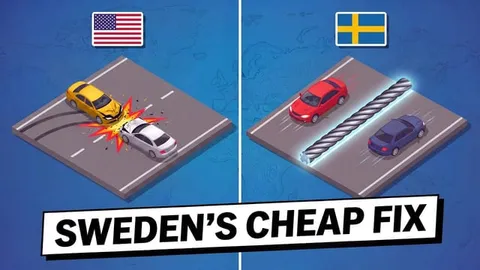
Why America Won't Copy Sweden's Cheap Highway Fix
 Safe By Design
Explains Sweden's 2+1 alternating-passing-lane cable-barrier retrofit and the specific AASHTO Green Book barriers (literally) that have kept the same fix from scaling in the US.
MED-013 Aligned
Ep 3: Beth Osborne - Failures of the Federal Transportation Program
 High Frequency
Beth Osborne explains why the federal transportation program keeps failing, from highways prioritized over maintenance to speed-based metrics that ignore safety. It frames the policy backdrop for the Commonway System's design-speed-equals-posted-speed rule.
MED-061#References
- Legal / regulatory Civil Rights Litigation Clearinghouse. "Case: Willits v. City of Los Angeles," No. 2:10-cv-05782 (C.D. Cal.).(opens in new tab)
- Precedent-based "New Legal Details Emerge on L.A.'s City Sidewalk Repair Settlement." Streetsblog California, January 13, 2016.(opens in new tab)
- Legal / regulatory Design Standards for Highways. 23 C.F.R. §§ 625.3-625.4.(opens in new tab)
- Precedent-based National Association of City Transportation Officials. "About NACTO."(opens in new tab)
- Legal / regulatory ⚠ Federal Highway Administration. "Bicycle and Pedestrian Facility Design Flexibility." Memorandum, August 20, 2013, and Q&A update, July 2014.(opens in new tab) Verified through NACTO's and the Silicon Valley Bicycle Coalition's reports of the memo; fhwa.dot.gov blocks automated reading.
- Legal / regulatory Federal Highway Administration. Manual on Uniform Traffic Control Devices for Streets and Highways, 11th ed., Part 1, Section 1C.01. Washington, DC: FHWA, 2023.(opens in new tab)
- Precedent-based American Association of State Highway and Transportation Officials. "About AASHTO."(opens in new tab)
- Legal / regulatory U.S. Access Board. "Public Right-of-Way Accessibility Guidelines (PROWAG)."(opens in new tab)
- Legal / regulatory U.S. Access Board. "DOT Adopts Access Board's Public Right-of-Way Accessibility Guidelines into Enforceable Standards." December 18, 2024.(opens in new tab)
- Legal / regulatory Hayes, Jahana, et al. Letter to Assistant Attorney General Harmeet K. Dhillon urging DOJ adoption of the Public Right-of-Way Accessibility Guidelines. U.S. House of Representatives, February 20, 2026.(opens in new tab)
- Legal / regulatory Traffic Control Devices on Federal-Aid and Other Streets and Highways. 23 C.F.R. § 655.603.(opens in new tab)
- Precedent-based Smart Growth America. "National Complete Streets Coalition."(opens in new tab)
- Precedent-based Smart Growth America. "20 Years, 1,600 Complete Streets Policies."(opens in new tab)
- Precedent-based ⚠ SWOV Institute for Road Safety Research.(opens in new tab) Site blocks automated reading; description verified through the National Road Safety Partnership Program (Australia) listing.
- Precedent-based CROW. "Over CROW" [About CROW].(opens in new tab)
- Legal / regulatory U.S. Environmental Protection Agency. "About Green Infrastructure."(opens in new tab)
- Precedent-based ITE. "About ITE."(opens in new tab)
- Precedent-based Strong Towns. "About."(opens in new tab)
- Precedent-based Congress for the New Urbanism. "Who We Are."(opens in new tab)
- Precedent-based Vision Zero Network. "About the Vision Zero Network."(opens in new tab)
- Legal / regulatory Federal Highway Administration. "Zero Deaths and Safe System."(opens in new tab)
- Precedent-based Project for Public Spaces. "About."(opens in new tab)
- Precedent-based Create Streets. "Our Story."(opens in new tab)
- Precedent-based CROW. Design Manual for Bicycle Traffic. CROW Platform.(opens in new tab)
- Precedent-based Institute for Transportation and Development Policy. "About Us."(opens in new tab)
- Precedent-based Institute for Transportation and Development Policy. The BRT Standard.(opens in new tab)