
Retrofits · Corridor
RFT-CDR-03Lane diet
Narrows existing travel lane widths without removing a lane, reclaiming the width difference for a bike lane, wider sidewalk, or buffer.
Strategy viewer
No illustration of Lane diet has been made yet. Interactive views are planned for every pattern and Retrofit Strategy.
#Overview
Where a road diet removes a whole lane, a lane diet keeps the same lane count but makes each lane narrower, typically down to 10 or 10.5 feet from a wider original width. This is a lighter-touch alternative, useful where traffic volume doesn't support removing a lane but the existing lanes are wider than necessary for safe operation.
Related Media
 Aligned
The Airtight Case for Road Diets
 Streetsblog USA
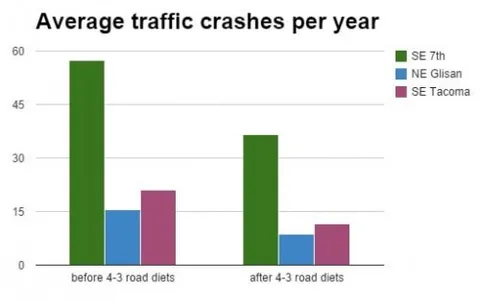
The article lays out the evidence for four-to-three lane conversions, citing FHWA data showing 20 to 50 percent crash reductions with minimal capacity effects. It is the evidence summary behind the Commonway System's four-to-three road diet retrofit strategy.
MED-047 Aligned
Fabulous Ferndale (Ep 436)
 The Overhead Wire
Ferndale, Michigan's mayor describes the city's road diet of eight-lane Woodward Avenue and the practical politics of working with the state DOT. It is a practitioner-level case study for the Commonway System's road diet strategies.
MED-065#Where this leads: Target patterns
- Default (Standard Collector) (COL-DEF-01)
- Default (No Parking, No Direct Access) (ART-DEF-01)
#Applicability and thresholds
Appropriate on corridors where lane count must stay the same, due to volume or a jurisdiction's unwillingness to remove a lane, but where existing lanes exceed the width actually needed for safe operation at the corridor's design speed.
#Evidence and effectiveness
A Canadian Institute of Transportation study presented in 2015 found side-impact and turn-related crash rates lowest where average lane widths fall between 10 and 10.5 feet, challenging the assumption that wider lanes are inherently safer.1
#Getting it built
Can move through the construction spectrum easily, since restriping to a narrower lane width is typically a paint-only change, well suited to a demonstration or pilot stage before permanent striping. See Construction Methodology & The Build Spectrum.
No formal decision process is typically required, since lane count is unchanged.
#Who can move this
Usually a city or county public works decision, achievable through routine restriping without new legislation. See Legal & Planning Mechanisms.
#Related retrofit strategies
- Four-to-three lane road diet (RFT-CDR-01) (the more aggressive alternative where lane count itself can be reduced)