
Retrofits · Network
RFT-NET-02Superblock retrofit
Groups several existing blocks into a single traffic cell, routing through-traffic around the perimeter while reclaiming the interior streets for pedestrians, bicyclists, and local access only.
Strategy viewer
No illustration of Superblock retrofit has been made yet. Interactive views are planned for every pattern and Retrofit Strategy.
#Overview
Where modal filtering works point by point, a superblock works by treatment area: an entire multi-block zone is reorganized at once, with clearly designated perimeter streets carrying all through-traffic and interior streets rebuilt for a much lower level of vehicle priority, sometimes fully pedestrianized. Barcelona's and Vienna's programs are the most documented examples, using this as a deliberate top-down planning model rather than an incremental, street-by-street change.
Related Media
3 items
 Aligned(opens in new tab)
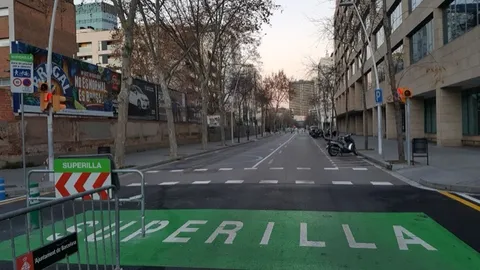
Could COVID-19 Finally be the Superblock's U.S. Moment?
 Streetsblog USA
The article covers Barcelona's superblock expansion and argues US cities test-drove the concept through pandemic Slow Streets. It is a readable introduction to the Commonway System's superblock retrofit strategy.
MED-055 Aligned(opens in new tab)
Episode 102: CONSPIRACY!
 The War on Cars
The episode uses the 15-minute-city panic as a frame to explain real traffic circulation plans, from Ghent and Groningen to Barcelona's superblocks and London's low-traffic neighbourhoods. It is a substantive tour of the modal filtering measures the Commonway System catalogs.
MED-062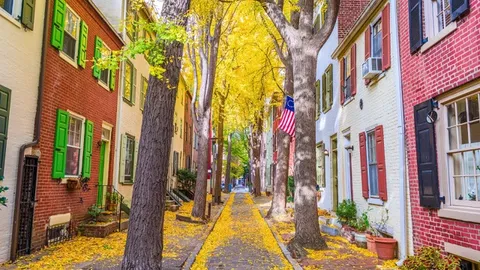 Aligned(opens in new tab)
Can U.S. Cities Build Narrow European Streets?
 City Beautiful
The video contrasts rigid, car-scaled American grids with the organic narrow streets of older European cities, using Philadelphia's Elfreth's Alley and Quince Street as rare U.S. examples, and names fire-truck access, parking minimums and zoning as the barriers to building more. It is a direct look at the Commonway System's Grid and Organic/Irregular network patterns and the narrow, shared local street patterns, from Alley to Living Street and Pedestrian Plaza.
MED-072
#Where this leads: Target patterns
As with modal filtering, this doesn't necessarily produce a different destination pattern, it applies within an existing network's topology rather than replacing it. A superblock applied within a Grid (NET-GRD-01) leaves it a Grid. Interior streets within the superblock typically become Living Street / Woonerf (LOC-LSW-06) or Pedestrian-only Street / Plaza (LOC-PED-09), while perimeter streets retain or gain through-traffic capacity.
#Applicability and thresholds
Requires a multi-block area with a genuine perimeter capable of absorbing the rerouted through-traffic without creating unacceptable congestion or diversion onto adjacent neighborhoods. A Grid topology is again the most amenable context, given its inherent route redundancy along the perimeter.
#Evidence and effectiveness
The superblock model is documented as reallocating street space from motorised traffic to active travel and public use at the scale of an entire neighborhood or set of residential blocks, a top-down urban planning model distinct from the more incremental, street-by-street approach of modal filtering alone.1
#Getting it built
Given its area-wide scope, this retrofit is rarely demonstrated at full scale in a single short pilot; a phased approach, testing perimeter rerouting and one or two interior streets before committing to the full superblock, is more typical than a citywide or neighborhood-wide launch. See Construction Methodology & The Build Spectrum.
#Who can move this
Typically a city-level planning and transportation department initiative, given the scale, often requiring a dedicated area plan or district designation rather than a single project approval. See Legal & Planning Mechanisms.
#Related retrofit strategies
- Modal filtering / Low Traffic Neighborhood retrofit (RFT-NET-01) (a related, more incremental approach that restricts through-traffic without necessarily rebuilding the interior streets themselves)