
Retrofits · Intersection
RFT-INT-01Signal-to-roundabout conversion
Replaces an existing signalized intersection with a roundabout, removing signal equipment and phasing entirely in favor of continuous yield-controlled circulation.
Strategy viewer
No illustration of Signal-to-roundabout conversion has been made yet. Interactive views are planned for every pattern and Retrofit Strategy.
#Overview
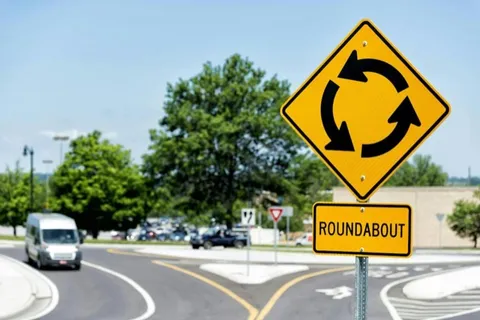
A signal manages conflict by separating movements in time; a roundabout manages it by separating movements in space, requiring every entering vehicle to yield to circulating traffic rather than wait for a green phase. This retrofit is the most direct route between Signal and the Commonway System's own default intersection control, and is the concrete mechanism behind the System's broader roundabouts-first philosophy.
Related Media

#Where this leads: Target patterns
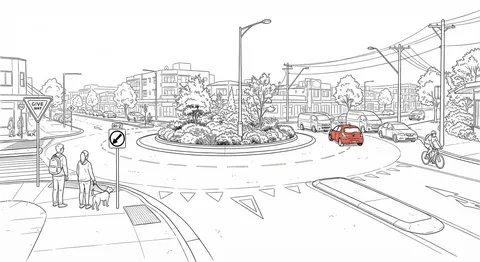
- Roundabout (Single/Multi-Lane) (INT-RAB-01)
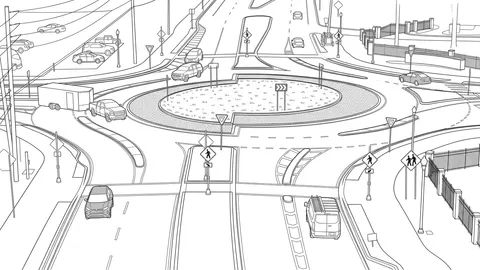
- Turbo-Roundabout (INT-TRB-02) at the highest-volume Arterial-to-Arterial locations
#Applicability and thresholds
Applicable at nearly any signalized intersection where right-of-way exists or can be acquired for the roundabout's circular footprint. Volume alone rarely disqualifies a location, since multi-lane and turbo-roundabout designs scale to high-volume conditions, but right-of-way constraints and adjacent property impacts are the most common practical limits.3
#Evidence and effectiveness
FHWA reports roundabouts reduce overall crashes by 35 percent, injury crashes by 76 percent, and fatal crashes by 90 to 100 percent compared to the signals or stop signs they replace.1 An Insurance Institute for Highway Safety empirical Bayes study of U.S. roundabout conversions found a crash modification factor of 0.801, an approximately 20 percent reduction in crashes overall.2
#Getting it built
Cannot be meaningfully piloted or demonstrated. A roundabout requires real construction, new pavement, curbs, and central island, to exist at all; there's no reversible, low-cost version of this conversion. This strategy effectively starts at Permanent on the construction spectrum. See Construction Methodology & The Build Spectrum.
An Intersection Control Evaluation is standard practice before this conversion, comparing the roundabout against retaining or upgrading the signal using the same safety and operational data. See Decision & Evaluation Processes.
#Who can move this
Typically a city, county, or state DOT capital project, given the construction scope and cost. Right-of-way needs may bring in acquisition or easement tools. See Legal & Planning Mechanisms and Funding & Financing Mechanisms.
#Related retrofit strategies
None currently cataloged.
#References
- Evidence-based Federal Highway Administration, "Roundabouts," Intersection Safety.(opens in new tab)
- Evidence-based Persaud, B. et al., "Safety Effect of Roundabout Conversions in the United States: Empirical Bayes Observational Before-After Study," Insurance Institute for Highway Safety, 2001.(opens in new tab)
- Legal / regulatory Rodegerdts, L. et al., Roundabouts: An Informational Guide, 2nd ed., NCHRP Report 672, Transportation Research Board, 2010.(opens in new tab)