
Retrofits · Corridor
RFT-CDR-09Protected bike lane retrofit via parking reduction
Installs a physically separated bike lane by removing or reconfiguring on-street parking, often placing the bike lane where parking used to be and shifting parking, if retained, to the outside of a physical buffer.
Strategy viewer
No illustration of Protected bike lane retrofit via parking reduction has been made yet. Interactive views are planned for every pattern and Retrofit Strategy.
#Overview
This is the parking-specific case of Parking-Lane Reallocation, applied to bike facilities. A common configuration keeps some parking but moves it away from the curb, using the parked cars themselves as part of the physical buffer protecting the bike lane between the parking lane and the sidewalk.
Related Media
 Aligned
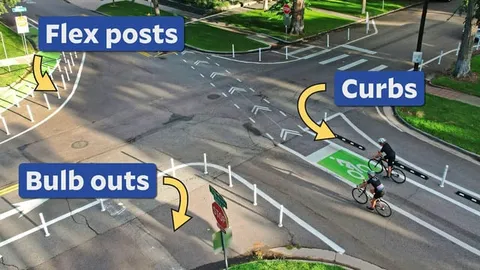
Are Streets Too Complicated Now?
 City Beautiful
Asks whether today's proliferation of lines, signals, and lane types on streets is overcomplication or a needed response to modern demands, a question that runs directly through CS's Element-scale catalog and the density-tiered Corridor retrofit paths this video is tagged to.
MED-004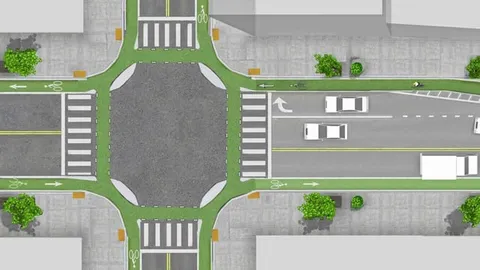 Aligned
Dutch-style intersection design: bike-friendly
 BicycleDutch
Shows the protected-intersection design vocabulary, continuous cycle tracks, corner refuge islands, separated signal phasing, that underpins CS's Protected Intersection pattern and the Corridor retrofit paths built around it.
MED-005#Where this leads: Target patterns
- Bike Highway / Greenway (COL-BHG-04)
- Default (Standard Collector) (COL-DEF-01) with Protected Bike Lane / Cycle Track (ELM-PBL-37)
#Applicability and thresholds
Most applicable where on-street parking demand analysis shows capacity to reduce or relocate parking without materially harming adjacent businesses or residents, and where lane width or count changes alone don't recover sufficient space.
#Evidence and effectiveness
AASHTO identifies reconfiguring or reducing on-street parking as one of three established retrofit approaches for adding bike facilities without widening the road.1 Removing parking near intersections specifically has documented safety benefits beyond the bike facility itself, improving sightlines between drivers and other road users.2
#Getting it built
Can move through the construction spectrum starting with temporary channelizers and paint at the pilot stage, since testing community and business response to the parking change before committing to permanent curb reconstruction is common and often politically necessary. See Construction Methodology & The Build Spectrum.
#Who can move this
Usually a city public works or planning department decision, though parking removal frequently requires more direct business and resident engagement than lane-width or lane-count retrofits, and may need city council involvement where removal is contested. See Legal & Planning Mechanisms.
#Related retrofit strategies
- Protected bike lane retrofit via lane-width reallocation (RFT-CDR-07)
- Protected bike lane retrofit via lane removal (RFT-CDR-08) (the other two approaches to the same underlying goal, distinguished by where the recovered width comes from)
- Parking-lane reallocation (RFT-CDR-05) (the general-purpose version of this same mechanism)
#References
- Evidence-based Transportation Policy Research, Texas A&M Transportation Institute, "Cycle Tracks." Retrofitting protected bike lanes by reallocating parking, underutilized lanes, or excess lane width.(opens in new tab)
- Evidence-based Federal Highway Administration University Course on Bicycle and Pedestrian Transportation Design, on parking removal and safety/capacity effects.(opens in new tab)