
Retrofits · Network
RFT-NET-03Barrier-crossing / network reconnection retrofit
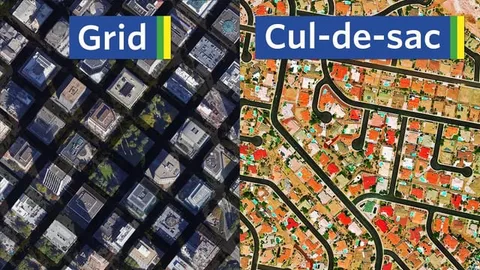
Adds a new pedestrian and bicycle connection, a bridge, tunnel, or path linkage, across a highway, rail line, or disconnected cul-de-sac pattern that currently severs an otherwise walkable or bikeable network.
Strategy viewer
No illustration of Barrier-crossing / network reconnection retrofit has been made yet. Interactive views are planned for every pattern and Retrofit Strategy.
#Overview
A network can be well-connected on paper and still function poorly for anyone not driving, if the connections that exist only work for cars. A limited-access highway, a railroad, or a subdivision built entirely from disconnected cul-de-sacs can each cut a walking or biking trip off at a distance a driver never notices, since a driver's route simply goes around. This retrofit adds the missing link directly, rather than requiring a long detour to the nearest through-street.
Related Media

#Where this leads: Target patterns
Like the other two Network-scale retrofits, this doesn't necessarily change a network's overall topology classification, it applies within it. A Dendritic / Hierarchical (NET-DEN-02) network with a new cross-connection added is measurably more connected for active travel, without becoming a Grid outright. The connection itself typically takes the form of a Shared-Use Path (LOC-SUP-13) or Multi-Use Trail / Greenway (COL-MUT-06) at the Local or Collector scale.
#Applicability and thresholds
Most applicable where Level of Traffic Stress analysis or similar network connectivity research shows a barrier, a highway, rail corridor, or cul-de-sac pattern, is forcing an unreasonable detour for active travel, commonly assessed against a threshold such as a 25 percent detour penalty compared to the most direct path.2
#Evidence and effectiveness
Low-stress connectivity research finds cities are often divided into disconnected islands of otherwise-comfortable walking and biking conditions, separated by barriers that can only be crossed using high-stress links; adding a dedicated crossing directly addresses that fragmentation without requiring the barrier itself, the highway or rail line, to change at all.1
#Getting it built
A single crossing (a path connection through an existing cul-de-sac stub) can sometimes be demonstrated informally, but a genuine bridge or tunnel across a highway or rail corridor requires real capital construction and effectively starts at Permanent on the construction spectrum. The two cases differ substantially, and each specific project should be assessed on its own rather than assuming one pattern for all barrier types. See Construction Methodology & The Build Spectrum.
#Who can move this
Varies significantly by barrier type. A local street reconnection is often a city or county decision; a highway or rail crossing typically requires state DOT or rail authority coordination given jurisdiction over the barrier itself. See Legal & Planning Mechanisms and Funding & Financing Mechanisms.
#Related retrofit strategies
None currently cataloged.
#References
- Evidence-based Federal Highway Administration, "Part 2: Reducing Conflicts," Multimodal Networks, Bicycle and Pedestrian Program, on cul-de-sac connectivity and barrier crossings.(opens in new tab)
- Evidence-based Mineta Transportation Institute, "Low-Stress Bicycling and Network Connectivity," MTI Report 11-19, Level of Traffic Stress and detour-based connectivity measures.(opens in new tab)