
Retrofits · Network
RFT-NET-01Modal filtering / Low Traffic Neighborhood retrofit
Installs a scattered set of point closures across a residential area, restricting motor vehicle through-traffic on interior streets while preserving full access for residents, deliveries, and emergency services, and full passage for pedestrians and bicyclists.
Strategy viewer

No illustration of Modal filtering / Low Traffic Neighborhood retrofit has been made yet. Interactive views are planned for every pattern and Retrofit Strategy.
#Overview
Rather than redesigning any single street, this retrofit changes how an entire area functions by selectively blocking through-driving routes at chosen points. The area's streets remain physically unchanged except at the closures themselves; what changes is which trips are still possible by car. A driver can still reach any address inside the filtered area, but can no longer use it as a shortcut between two points outside it.
Related Media
4 items
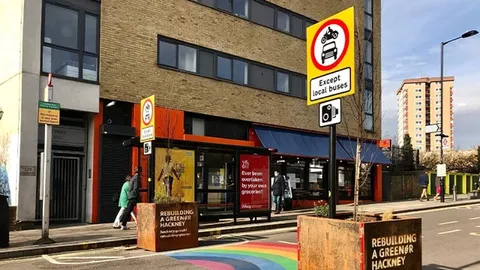 Aligned(opens in new tab)
Dr Rachel Aldred and Asa Thomas for The Guardian on how low-traffic neighbourhoods do not push traffic onto other roads
University of WestminsterThe piece summarizes peer-reviewed research on 46 London low-traffic neighbourhoods, finding motor traffic fell by a third inside with little displacement to boundary roads. It is direct evidence for the Commonway System's modal filtering retrofit strategy.
MED-051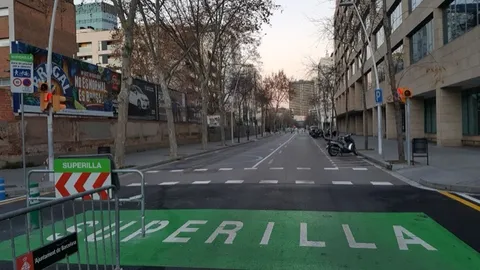 Aligned(opens in new tab)
Could COVID-19 Finally be the Superblock's U.S. Moment?
 Streetsblog USA
The article covers Barcelona's superblock expansion and argues US cities test-drove the concept through pandemic Slow Streets. It is a readable introduction to the Commonway System's superblock retrofit strategy.
MED-055 Aligned(opens in new tab)
Episode 102: CONSPIRACY!
 The War on Cars
The episode uses the 15-minute-city panic as a frame to explain real traffic circulation plans, from Ghent and Groningen to Barcelona's superblocks and London's low-traffic neighbourhoods. It is a substantive tour of the modal filtering measures the Commonway System catalogs.
MED-062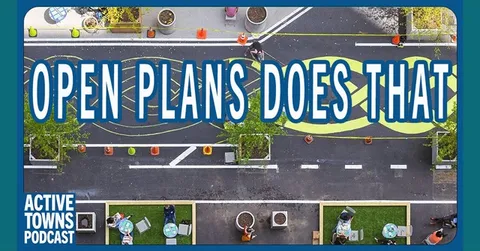 Aligned(opens in new tab)
Open Plans (Ep 341)
Active Towns PodcastThe episode covers Open Plans' New York campaigns for school streets, low-traffic neighbourhoods, and intersection daylighting. It shows the Commonway System's modal filtering and traffic calming measures in campaign form.
MED-068
#Where this leads: Target patterns
Unlike every Corridor and Intersection strategy, this doesn't produce a different destination pattern, it applies within an existing pattern or topology, changing a property (permeability) rather than replacing it. A filtered Grid (NET-GRD-01) is still a Grid. It changes the network's effective permeability within whatever topology already exists. Grid is the most common context for this retrofit, since a grid's redundant routes are what make filtering possible without stranding any address. At the Local scale, filtered streets typically read as Bicycle Boulevard / Neighborhood Greenway (LOC-BBG-12), built using the Modal Filter / Point Closure (ELM-MFP-44) element at each closure point.
#Applicability and thresholds
Requires enough route redundancy in the underlying network that closing a through-route doesn't strand any address or eliminate emergency access; a Grid or well-connected network is far more amenable to this retrofit than a Dendritic or cul-de-sac-heavy network, where fewer alternate routes exist.
#Evidence and effectiveness
Research on London's outer-borough Low Traffic Neighbourhoods, using the People and Places Survey, documents measurable reductions in car use and increases in active travel following modal filter installation, with over 25,000 modal filters already in place across the UK before 2020.12
#Getting it built
Well suited to the early construction spectrum stages. A single filter can be demonstrated with planters, and an area-wide network of filters is commonly piloted before permanent bollards or curb reconstruction, since resident and emergency-service response to the full filtered network is easier to evaluate after living with a temporary version. See Construction Methodology & The Build Spectrum.
#Who can move this
Usually a city transportation or public works department decision, often following resident petition or a council-directed neighborhood traffic study, since the area-wide scope affects many residents at once. See Legal & Planning Mechanisms.
#Related retrofit strategies
- Superblock retrofit (RFT-NET-02) (a related, more comprehensive area-wide approach that also reallocates the interior street space itself, not just its through-traffic access)
#References
- Evidence-based Aldred, R. and Goodman, A., "Low Traffic Neighbourhoods, Car Use, and Active Travel: Evidence from the People and Places Survey of Outer London Active Travel Interventions," Findings, 2020.(opens in new tab)
- Precedent-based "Identification of Plausible Low Traffic Neighbourhoods Using Open Data," ScienceDirect, definitions of modal filter, permeability, and filtered permeability.(opens in new tab)