
Grid
NET-GRD-01 Grid
Related Media
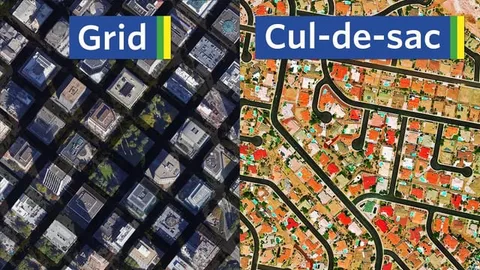 Aligned
The Reason Our Streets Switched to Cul-De-Sacs
 City Beautiful
Traces the postwar shift from connected grid networks to tree-shaped cul-de-sac subdivisions, then covers the same shared-use-path connector strategy CS's Network Reconnection retrofit recommends for stitching disconnected cul-de-sacs back into the surrounding network.
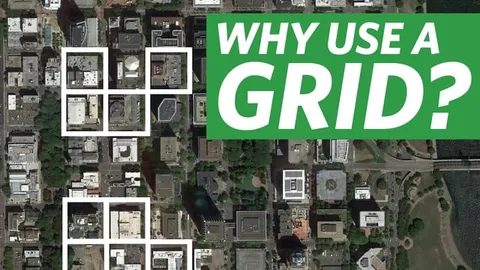 Aligned
Why do so many U.S. cities have gridded streets?
City BeautifulTraces how the grid became the default American street pattern, from William Penn's Philadelphia through Jefferson's Midwest land ordinances, historical background for why the Grid network topology pattern is so dominant in U.S. contexts.
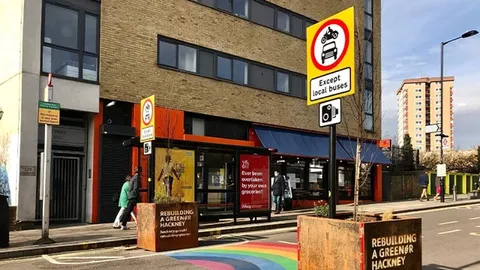 Aligned
Dr Rachel Aldred and Asa Thomas for The Guardian on how low-traffic neighbourhoods do not push traffic onto other roads
The piece summarizes peer-reviewed research on 46 London low-traffic neighbourhoods, finding motor traffic fell by a third inside with little displacement to boundary roads. It is direct evidence for the Commonway System's modal filtering retrofit strategy.
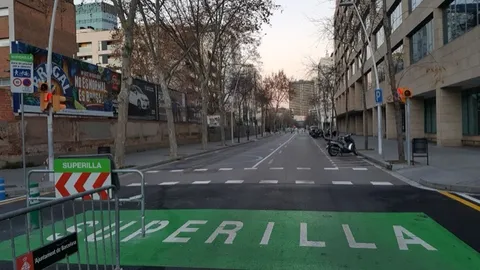 Aligned
Could COVID-19 Finally be the Superblock's U.S. Moment?
 Streetsblog USA
The article covers Barcelona's superblock expansion and argues US cities test-drove the concept through pandemic Slow Streets. It is a readable introduction to the Commonway System's superblock retrofit strategy.
 Aligned
Can U.S. Cities Build Narrow European Streets?
City BeautifulThe video contrasts rigid, car-scaled American grids with the organic narrow streets of older European cities, using Philadelphia's Elfreth's Alley and Quince Street as rare U.S. examples, and names fire-truck access, parking minimums and zoning as the barriers to building more. It is a direct look at the Commonway System's Grid and Organic/Irregular network patterns and the narrow, shared local street patterns, from Alley to Living Street and Pedestrian Plaza.
#Why this pattern exists
Grid is one of the most common and longest-documented network topologies worldwide, prized for the route choice and connectivity it offers: because most intersections allow through-travel in multiple directions, traffic is not forced onto a small number of bottleneck routes the way a more hierarchical network can produce. This pattern documents that base topology before any of the modifiers (Superblock/Cellular) or contrasting topologies (Dendritic/Hierarchical, Radial, Organic/Irregular) that relate to it.12
#Key considerations
- Connectivity and route choice are the grid’s core strength, but this also means it produces more total pavement, more blocks, and more intersections per unit area than more hierarchical alternatives
- A grid can be paired with the Superblock/Cellular modifier to filter through-traffic from interior cells while preserving the grid’s overall connectivity for walking, cycling, and emergency access
- Historic gridiron patterns and modern grid-based neotraditional developments both fall under this pattern, even though they differ in block size and detail
#Related patterns
Dendritic/Hierarchical (NET-DEN-02), Radial (NET-RAD-03), Organic/Irregular (NET-ORG-04) (contrasting Network topologies); Superblock/Cellular (a modifier applied to this pattern, not a separate topology)
#References
- Precedent-based Southworth, Michael, and Eran Ben-Joseph. Streets and the Shaping of Towns and Cities. Rev. ed. Washington, DC: Island Press, 2003. Chapter 5, "Streets for Living," pp. 105-107. Print/ebook source, no persistent URL to monitor.
- Precedent-based Marshall, Stephen. Streets and Patterns. London: Spon Press, 2005. Chapter 4, "Pattern Type," "Developing Typologies of Pattern" (ABCD typology, B-type/Bilateral), pp. 83-96. Print/ebook source, no persistent URL to monitor.