
Patterns · Elements
ELM-MFP-44 RecommendedModal Filter / Point Closure
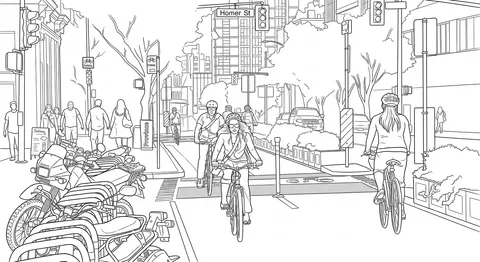
A physical closure placed mid-block or at an intersection leg that blocks through motor vehicle travel while preserving passage for pedestrians and bicyclists, using bollards, planters, partial curb extensions, or a similar barrier.
Pattern viewer
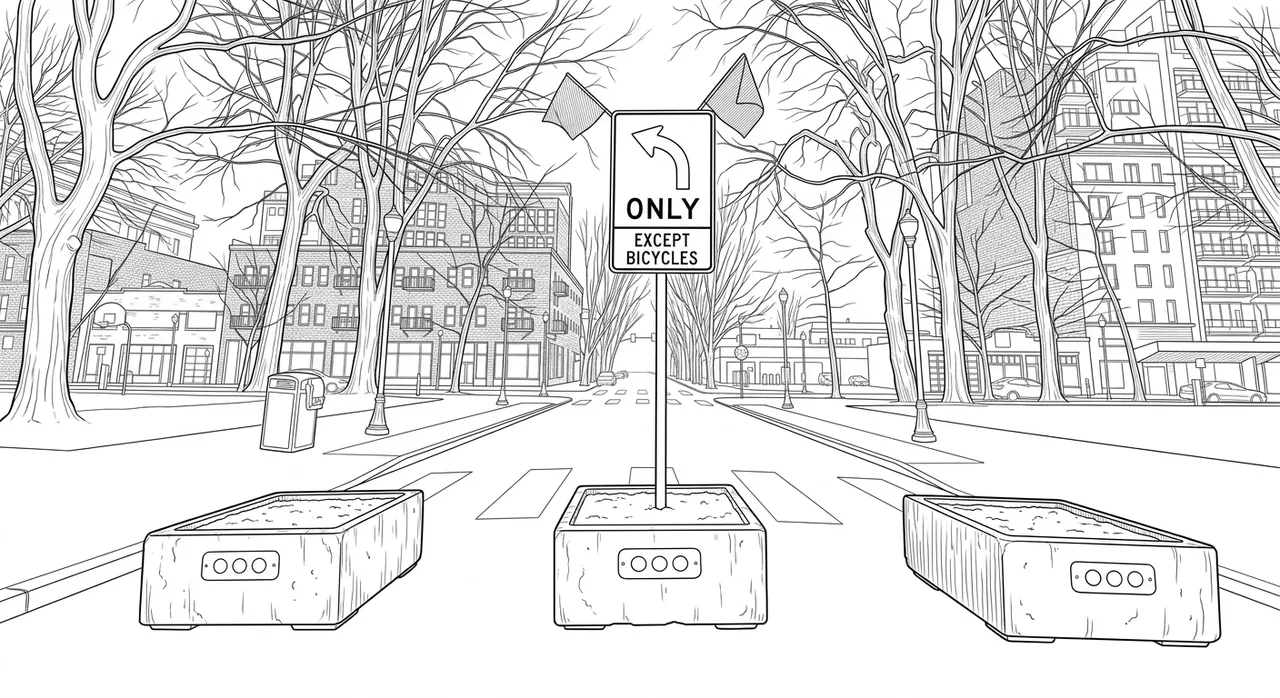
An overview illustration of Modal Filter / Point Closure. Interactive views haven't been built yet.
Related Media
5 items
 Aligned(opens in new tab)
Are Streets Too Complicated Now?
 City Beautiful
Asks whether today's proliferation of lines, signals, and lane types on streets is overcomplication or a needed response to modern demands, a question that runs directly through CS's Element-scale catalog and the density-tiered Corridor retrofit paths this video is tagged to.
MED-004 Aligned(opens in new tab)
The Bike Lanes You Can't See - Ontvlechten
 Not Just Bikes
The video explains ontvlechten, the Dutch practice of disentangling car and bicycle traffic into separate hierarchical networks. It is a worked example of the Commonway System's cycling facilities and network patterns, showing how filtered permeability keeps bike routes safe and direct.
MED-023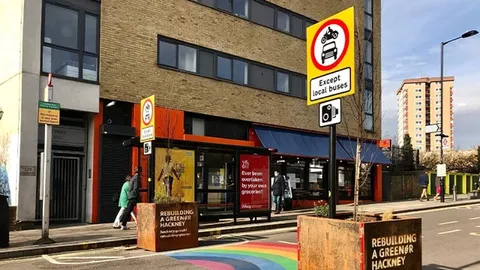 Aligned(opens in new tab)
Dr Rachel Aldred and Asa Thomas for The Guardian on how low-traffic neighbourhoods do not push traffic onto other roads
University of WestminsterThe piece summarizes peer-reviewed research on 46 London low-traffic neighbourhoods, finding motor traffic fell by a third inside with little displacement to boundary roads. It is direct evidence for the Commonway System's modal filtering retrofit strategy.
MED-051 Aligned(opens in new tab)
Episode 102: CONSPIRACY!
 The War on Cars
The episode uses the 15-minute-city panic as a frame to explain real traffic circulation plans, from Ghent and Groningen to Barcelona's superblocks and London's low-traffic neighbourhoods. It is a substantive tour of the modal filtering measures the Commonway System catalogs.
MED-062 Aligned(opens in new tab)
Open Plans (Ep 341)
Active Towns PodcastThe episode covers Open Plans' New York campaigns for school streets, low-traffic neighbourhoods, and intersection daylighting. It shows the Commonway System's modal filtering and traffic calming measures in campaign form.
MED-068
#Why this pattern exists
A street network's permeability, how easily a route can be used for through travel, isn't the same for every mode. A modal filter exploits that difference on purpose: it removes a street's usefulness as a through route for motor vehicles while leaving it fully useful, often more pleasant, for anyone walking or biking.12 This is the physical mechanism underneath both the Modal filtering / Low Traffic Neighborhood retrofit and Superblock retrofit Retrofit Strategies at the Network scale; those Retrofit Strategies describe the area-wide pattern of closures, this pattern documents the closure itself.
#Key considerations
- Passage width for pedestrians and bicyclists must be genuinely usable, not a minimum legal gap, and should account for cargo bikes, adaptive cycles, and mobility devices
- Emergency vehicle access needs an explicit plan: a fixed closure without a removable, retractable, or otherwise overridable component can create a real response-time problem, not just a design inconvenience
- Signage should state plainly that the street is closed to through motor traffic while remaining open to residents, deliveries, and emergency access where applicable, since an unmarked or ambiguous closure generates confusion and unauthorized attempts to pass
- Materials can span the full construction spectrum, from a demonstration-stage planter arrangement to a permanent, engineered barrier; see Construction Methodology & The Build Spectrum
#Related patterns
- Bollard (ELM-BOL-25) (the hardware most commonly used to build a filter)
- Curb Extension (ELM-CBE-02) (an alternative geometry for narrowing or partially closing a street)
- Bicycle Boulevard / Neighborhood Greenway (LOC-BBG-12) (the Local Street pattern this is most frequently paired with)
#Getting there: Retrofit path options
This Element is the direct physical product of Modal filtering / Low Traffic Neighborhood retrofit (RFT-NET-01), the Network-scale strategy that places a coordinated set of these closures across an area.
#References
- Evidence-based Aldred, R. and Goodman, A., "Low Traffic Neighbourhoods, Car Use, and Active Travel: Evidence from the People and Places Survey of Outer London Active Travel Interventions," Findings, 2020.(opens in new tab)
- Legal / regulatory Federal Highway Administration, "Traffic Calming ePrimer," Module 3: Toolbox of Individual Traffic Calming Measures. Diagonal diverters and half closures as routing-restriction treatments.(opens in new tab)