
Bicycle Boulevard / Neighborhood Greenway
LOC-BBG-12 Bicycle Boulevard / Neighborhood Greenway
Typical at: Compact Urban Core
Suburban is an edge case, thinning for the same reason as Continuous Sidewalk / Raised Junction: a disconnected, cul-de-sac-heavy grid gives it fewer parallel, low-traffic routes to use. Undeveloped and Rural are unlikely pairings.
#Illustration
Callouts
- (Physical) Modal diverter / traffic circle blocking through car movement; a bicycle-width gap allows continuous bicycle passage.
- (Physical) Wayfinding signage marking the route as a through bicycle connection.
- (Control-timing) At crossings of higher-volume streets, a signalized or protected crossing reduces bicyclist delay.1
No supplemental illustration needed.
Related Media
 Aligned
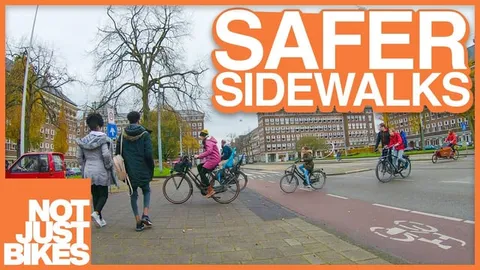
The Dutch Solution for Safer Sidewalks - Continuous Sidewalks
 Not Just Bikes
Shows the same sidewalk-continuity concept behind Continuous Sidewalk / Raised Junction in practice: the roadway rises to meet the sidewalk at a crossing, rather than the sidewalk dropping to meet the road, so geometry itself signals the priority shift.
 Aligned
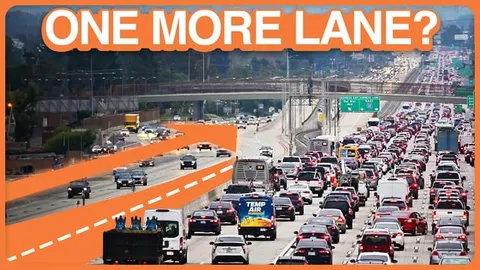
More Lanes Are (Still) A Bad Thing
Not Just BikesLays out induced demand, Braess's Paradox, and traffic evaporation with real case studies (LA 405, Houston Katy Freeway, Cheonggyecheon), then shows the Dutch one-lane-plus-transit cross-section as the actual fix.
#Speed and modal hierarchy
Design speed & speed limit
Modal hierarchy
#Design notes
Traffic calming and diverters discourage through car traffic while retaining local access, the reverse of a Collector-scale Bike Highway / Greenway's full physical separation. NACTO's guidance sets the design threshold where the treatment works: daily motor vehicle volume at or below 3,000 and a 95th-percentile speed at or below 25 mph, with heavier calming needed above those figures.1
A comparison of Berkeley's bicycle boulevards to their parallel arterials found bicyclist collision rates two to eight times lower on the boulevards.2
#Related patterns
Bike Highway / Greenway (COL-BHG-04) — the Collector-scale pattern this one is explicitly distinguished from on that page: physical separation there, a shared, calmed roadway here.
Continuous Sidewalk / Raised Junction (INT-CSJ-06) — the Local-to-Collector intersection default, explicitly named alongside this pattern on that page as thinning in Suburban for the same grid-connectivity reason.
Modal Filter / Point Closure (ELM-MFP-44) — the Element pattern most frequently paired with this one to build the diversion shown above.
#Getting there: Retrofit path options
Parking-lane reallocation (RFT-CDR-05), Modal filtering / Low Traffic Neighborhood retrofit (RFT-NET-01, applies within this pattern rather than transforming it into something else)
#References
- Precedent-based National Association of City Transportation Officials, Urban Bikeway Design Guide, 3rd ed. (2025), "Bike Boulevards," in Designing Bikeways for All Ages and Abilities.(opens in new tab)
- Evidence-based Minikel, E., "Cyclist Safety on Bicycle Boulevards and Parallel Arterial Routes in Berkeley, California," Accident Analysis & Prevention 45 (2012): 241–247.(opens in new tab)