
Character Transect
CDR-CTR-03 Character Transect
Related Media
 Aligned
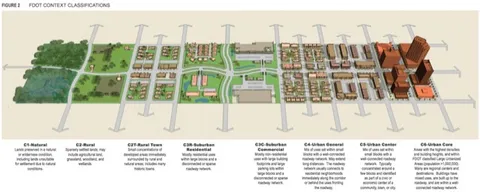
Will Florida's New Approach to Urban Streets Reduce Its Traffic Carnage?
 Streetsblog USA
The piece reports on FDOT's adoption of eight context classifications, from rural town to urban core, that set allowable design speeds, lane widths, and geometries from surrounding land use rather than functional class alone. It is a real-world example of the Commonway System's Character Transect idea: the same road deliberately changes character as the place around it changes.
 Aligned
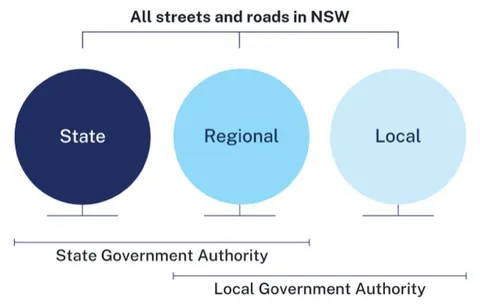
Identifying street environments
NSW's official framework sorts roads and streets into four environments, civic spaces, local streets, main streets, and main roads, by weighing movement function against place intensity, with 22 street types under them. It is the closest working government equivalent to the Link and Place thinking behind the Commonway System's Character Transect pattern.
 Aligned
Town entry gateway treatments
This design solution specifies what goes where a speed zone changes at a town or village arrival: enhanced signage, lane narrowing, and a colored threshold, with a real installation on the Monaro Highway at Bredbo. It is a concrete example of the Commonway System's density step-down principle: the road's design changes deliberately to tell drivers the density tier has changed.
 Aligned
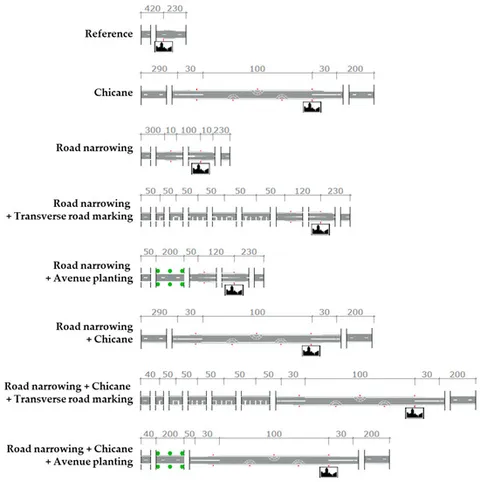
A Driving Simulator-Based Assessment of Traffic Calming Measures at High-to-Low Speed Transition Zones
The study tested seven gateway designs in a driving simulator and found physical measures like chicanes and road narrowing cut speeds at rural-to-urban transitions, while planting and markings alone did little. It supplies evidence for the Commonway System's claim that transitions between density tiers need deliberate design change, not just a new speed limit sign.
#Why this pattern exists
Most corridor-planning guidance treats a road as belonging to one classification for its full length, but real corridors regularly earn different classifications at different points because the land use around them changes. Without an explicit pattern for this, a corridor either gets forced into a single ill-fitting classification, or each segment gets designed in isolation with no coordination between them, producing a road that feels disjointed or unpredictable to travel along.12
#Key considerations
- Identify every context change point along the corridor before designing any single segment, so transitions are planned rather than discovered
- Each individual context change should be handled by its own applicable pattern (Density Step-Down/Step-Up, Rural-to-Town Gateway); this pattern is the umbrella that recognizes the corridor needs that sequencing at all
- A corridor with more than two or three context changes may indicate the corridor itself needs re-evaluation, not just better transitions
#Related patterns
Density Step-Down/Step-Up (CDR-DSD-01), Rural-to-Town Gateway (CDR-RTG-02) (component transitions this pattern sequences); Movement/Place diagnostic (Guide)
#References
- Precedent-based Jones, P., Boujenko, N., and Marshall, S. (2007), Link and Place: A Guide to Street Planning and Design.(opens in new tab)
- Precedent-based Duany Plater-Zyberk & Company, the rural-to-urban Transect (SmartCode, 2003).(opens in new tab)