
Pedestrian Hybrid Beacon
ELM-PHB-18 Pedestrian Hybrid Beacon
Related Media
 Aligned
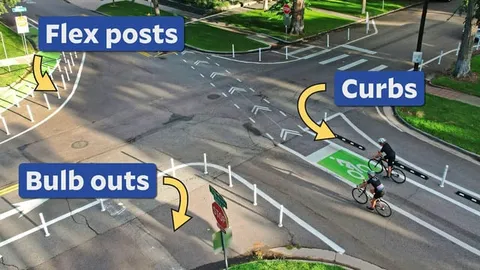
Are Streets Too Complicated Now?
 City Beautiful
Asks whether today's proliferation of lines, signals, and lane types on streets is overcomplication or a needed response to modern demands, a question that runs directly through CS's Element-scale catalog and the density-tiered Corridor retrofit paths this video is tagged to.
 Aligned
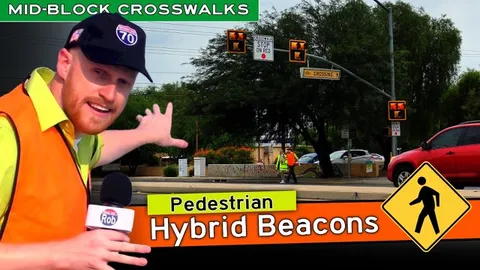
Can this "HAWK" STOP LIGHT make walking feel SAFE again?
 Road Guy Rob
Rob explains why painted mid-block crosswalks and flashing yellow lights are so often ignored, then shows how the Pedestrian Hybrid Beacon (HAWK), which stays dark until a pedestrian calls it and then commands a full stop, reaches 97 to 99 percent driver compliance, with Tucson's warrant and equity criteria. It supports the Commonway System's Pedestrian Hybrid Beacon pattern directly, and shows why the Crosswalk, RRFB and Pedestrian Signal patterns rate different devices differently.
#Why this pattern exists
A pedestrian hybrid beacon provides stronger, legally binding stop control than an RRFB while avoiding the ongoing delay a full traffic signal would impose on a corridor at a location that does not have enough pedestrian volume to justify constant signal timing. This pattern exists to document this middle-tier crossing treatment between an RRFB and a full signal.12
#Key considerations
- Most appropriate at crossings with meaningful but intermittent pedestrian volume on a higher-speed or higher-volume roadway where an RRFB’s advisory-only nature is not sufficient
- The dark-until-activated design should be paired with clear driver education or signage, since an unfamiliar driver may not immediately understand the sequence
- Requires adequate signage and lighting so the beacon itself is visible and comprehensible well before the crossing point
#Related patterns
RRFB (ELM-RRF-17) (the lighter-control alternative this pattern exceeds); Traffic Signal (ELM-TFS-14) (the heavier-control alternative this pattern avoids); Crosswalk (ELM-CRW-08), Pedestrian Safety Island/Refuge (ELM-PSI-09) (companion crossing elements)
#References
- Legal / regulatory MUTCD 11th Edition with Revision 1 (FHWA, December 2025; effective March 5, 2026), Chapter 4J, "Pedestrian Hybrid Beacons" (renumbered from the 2009 edition's Chapter 4F). Warrant conditions.(opens in new tab)
- Evidence-based Fitzpatrick, K. and Park, E.S., "Safety Effectiveness of the HAWK Pedestrian Crossing Treatment," FHWA-HRT-10-042 (2010). Tucson before/after study of 21 treatment sites versus 102 reference intersections: a 29% reduction in total crashes and a 69% reduction in pedestrian crashes.(opens in new tab)