
Two-Stage Turn Queue Box
ELM-TSQ-43 Two-Stage Turn Queue Box
Related Media
 Aligned
Are Streets Too Complicated Now?
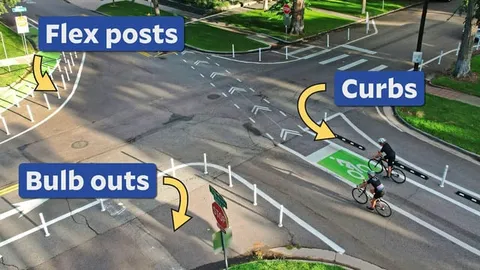
 City Beautiful
Asks whether today's proliferation of lines, signals, and lane types on streets is overcomplication or a needed response to modern demands, a question that runs directly through CS's Element-scale catalog and the density-tiered Corridor retrofit paths this video is tagged to.
 Aligned
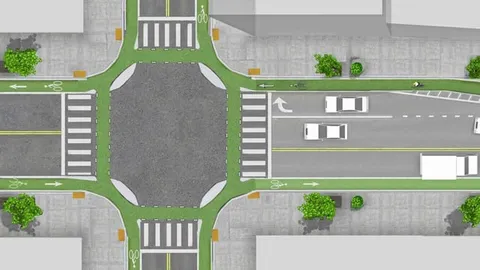
Dutch-style intersection design: bike-friendly
 BicycleDutch
Shows the protected-intersection design vocabulary, continuous cycle tracks, corner refuge islands, separated signal phasing, that underpins CS's Protected Intersection pattern and the Corridor retrofit paths built around it.
#Why this pattern exists
A conventional vehicle-style left turn asks a cyclist to merge across one or more lanes of traffic to reach a turn position, a maneuver that becomes increasingly stressful and dangerous as traffic volume, speed, or lane count increases; a two-stage turn queue box removes that merge entirely by breaking the turn into two straight crossings. This pattern exists to document this specific, well-established alternative to the conventional turning movement.1
#Key considerations
- Box placement and orientation must align with the cyclist’s path in the second stage of the crossing, so the movement reads as intuitive rather than requiring guesswork
- Most valuable at intersections with multi-lane approaches or higher traffic volume, where a conventional merge-and-turn movement would be most stressful
- Signal timing at the intersection needs to accommodate the two-stage movement, since a cyclist queued in the box is waiting for the second phase of the crossing, not simply out of the way
#Related patterns
Protected Bike Lane/Cycle Track (ELM-PBL-37), Bike Box (ELM-BKB-42) (related bike-specific intersection treatments); Roundabout (INT-RAB-01) (a different intersection default this pattern complements at signalized locations specifically)