
Patterns · Elements
ELM-NTC-46 RecommendedNeighborhood Traffic Circle / Mini-Roundabout
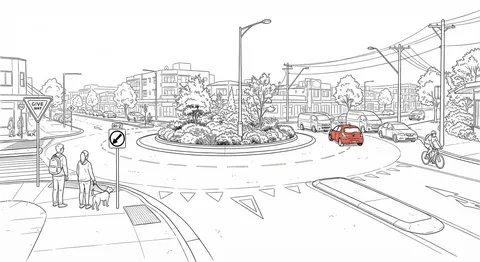
A small raised or landscaped island placed at the center of a Local-to-Local intersection, around which traffic circulates at low speed, used for calming rather than volume control.
Pattern viewer
No illustration of Neighborhood Traffic Circle / Mini-Roundabout has been made yet. Interactive views are planned for every pattern and Retrofit Strategy.
Related Media

#Why this pattern exists
Roundabout (Single / Multi-Lane) is sized to the volume it carries and is the default control wherever two Collector-or-higher streets meet; it isn't built for, and doesn't document, the much smaller intervention appropriate at a Local-to-Local intersection. This pattern exists to cover that gap: an intersection too low-volume to need a sized, engineered roundabout, but where an uncontrolled or minimally-controlled crossing still benefits from a physical feature that forces drivers to slow and negotiate rather than proceed straight through at speed.12
#Key considerations
- Sizing is deliberately minimal compared to Roundabout, matching Local street volumes and speeds rather than being engineered for Collector-or-higher throughput
- Sightlines around the circle must remain clear for all approaches, since the reduced scale means less margin for landscaping or signage to obstruct a driver's view of crossing traffic
- Emergency vehicle and larger-vehicle turning movements should be checked, since a mountable apron around the circle is often needed to accommodate a fire truck or moving van without requiring a larger footprint for every vehicle
- This pattern doesn't replace right-of-way rules at the intersection; signage or markings should make clear whether existing stop or yield control still applies
#Related patterns
- Roundabout (Single/Multi-Lane) (INT-RAB-01) (the sized, higher-volume analogue governed by different rules)
- All-Way Stop (INT-AWS-04) (a control type this pattern sometimes replaces at a Local intersection)
- Vertical Speed Control (ELM-VSC-06) (an alternative Local-to-Local calming treatment)
#References
- Precedent-based Delaware Department of Transportation, Traffic Calming Design Manual, 2025 edition, Section 3D, "Neighborhood Traffic Circles & Mini-Roundabouts."(opens in new tab)
- Precedent-based City of Auburn, Alabama, Engineering Services, Design and Construction Manual, Appendix J, "Examples of Traffic Calming Measures."(opens in new tab)