
Protected Intersection
INT-PRI-11 Protected Intersection
Related Media
 Aligned
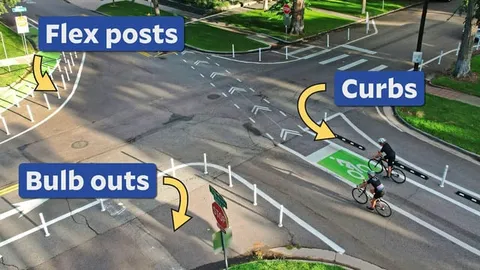
Are Streets Too Complicated Now?
 City Beautiful
Asks whether today's proliferation of lines, signals, and lane types on streets is overcomplication or a needed response to modern demands, a question that runs directly through CS's Element-scale catalog and the density-tiered Corridor retrofit paths this video is tagged to.
 Aligned
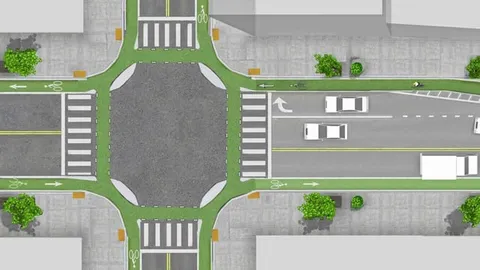
Dutch-style intersection design: bike-friendly
 BicycleDutch
Shows the protected-intersection design vocabulary, continuous cycle tracks, corner refuge islands, separated signal phasing, that underpins CS's Protected Intersection pattern and the Corridor retrofit paths built around it.
 Aligned
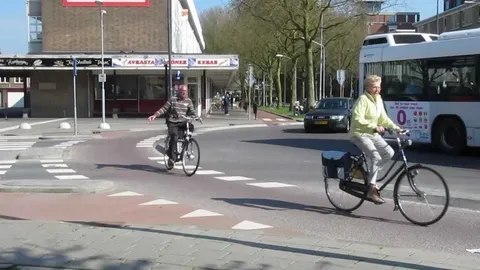
Roundabout with safe cycling facilities (Netherlands)
BicycleDutchA visual tour of a Dutch roundabout built with protected cycling facilities. It serves as a real-world reference for the Commonway System's roundabout and protected cycling intersection patterns.
 Counterexample
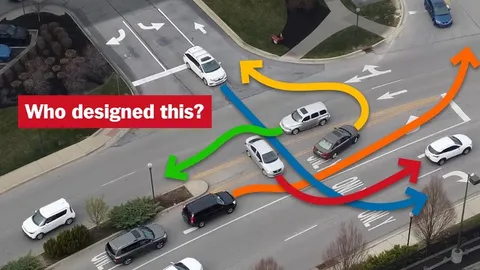
These Intersections Should Be Illegal
 Streetcraft
The video analyzes four badly designed American intersections, including an awkward roundabout and highway ramps that strand bike lanes. It is a cautionary companion to the Commonway System's intersection and cycling patterns, showing what failure looks like.
 Aligned
Bike lanes are not good enough
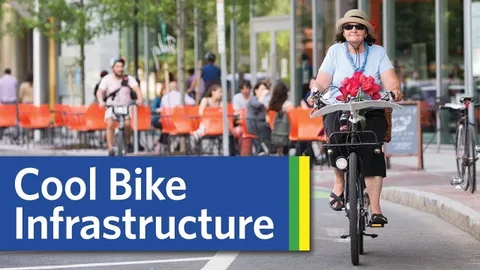
City BeautifulThe video argues that painted bike lanes fail and shows what works instead: cycle tracks, protected intersections, advisory lanes, plus a road-diet case study. It makes the case for the protected cycling facilities the Commonway System's bike patterns specify.
Typical at: Compact Urban Core
Suburban is an edge case. Undeveloped and Rural contexts are an unlikely pairing.
#Design notes
The first addition to Intersections & Crossings since the original ten. Addresses a specific, well-documented failure mode of conventional intersections, insufficient separation between turning vehicles and through bicycle/pedestrian traffic, that no other pattern in the set directly solves.1
Corner islands should provide genuine physical refuge, not a painted buffer alone. Crossing setback distance should give turning drivers a clear sightline and adequate reaction distance to pedestrians and cyclists.
Compatible with, and often paired with, Roundabout (INT-RAB-01) as the default intersection treatment.
#Turning trucks
Vehicles making a turn are involved in a disproportionate share of fatal pedestrian and cyclist crashes relative to vehicles going straight, and that risk rises sharply with vehicle size.23 See Signal for the general pattern.
Where a truck route runs through this intersection, setting the bicycle stop bar back keeps a cyclist waiting at the intersection out of a turning truck's swept path. Where a bicycle signal phase exists, separating bicycle and truck turning movements in time, not just space, closes the gap a setback stop bar alone cannot.4
#Related patterns
- Roundabout (Single/Multi-Lane) (INT-RAB-01)
#References
- Precedent-based Falbo, Nick, "Protected Intersections for Bicyclists," ProtectedIntersection.com (2014).(opens in new tab)
- Evidence-based U.S. Government Accountability Office, Pedestrian and Cyclist Safety: DOT Should Take Steps to Address Risks Related to Limited Driver Visibility, GAO-26-107954 (2026).(opens in new tab)
- Evidence-based Wang, Q. et al., "Exploring the Influencing Factors and Formation of the Blind Zone of a Semitrailer Truck in a Right-Turn Collision," Sustainability 14(16), 9805 (2022).(opens in new tab)
- Precedent-based Seattle Streets Illustrated, 3.11 "Freight" (setback bike lane stop bars and bicycle signals as tools against large-truck turning movements).(opens in new tab)