
Patterns · Intersections and Crossings
INT-MUT-12 Situational / DiscouragedMedian U-Turn (MUT)
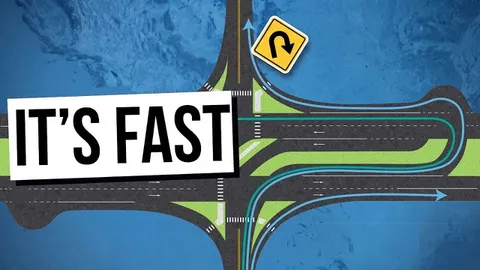
An intersection where left-turn movements from both the major and minor approaches are removed from the main crossing and rerouted through a downstream median crossover, requiring a driver to travel past the intersection, make a U-turn, then complete the turn from the opposite direction.
Pattern viewer
No illustration of Median U-Turn (MUT) has been made yet. Interactive views are planned for every pattern and Retrofit Strategy.
Related Media

Typical at: Rural Suburban
Compact is an edge case. Urban and Core are unlikely pairings.
#Design notes
This geometry exists to remove unprotected left turns from a major intersection entirely, rather than managing them with a longer signal phase.1 Doing so shortens the signal cycle the main intersection needs to run and reduces the conflict points a driver has to judge in a single movement.2 The tradeoff is a longer path for the rerouted turn and the median width needed to accommodate it, which is why this pattern is Situational rather than broadly Recommended: it solves a real problem well on a wide, higher-speed divided road, but doesn't fit a narrower cross-section or a genuinely low-speed context where Roundabout or a conventional Signal remains the better fit.
#Related patterns
- Restricted Crossing U-Turn (INT-RCU-13) (the related, more restrictive geometry that also removes the minor road's direct through movement)
- Displaced Left-Turn (INT-DLT-14) (an alternative approach to the same unprotected-left-turn problem)
- Signal (INT-SIG-03) (the conventional intersection this pattern modifies rather than replaces outright)
#Getting there: Retrofit path options
Median U-Turn (MUT) retrofit (RFT-INT-02) reroutes an existing conventional intersection's left-turn and through movements to this geometry.
#References
- Precedent-based Indiana Department of Transportation, "Median U-turns."(opens in new tab)
- Legal / regulatory Federal Highway Administration, "Chapter 2. Intersections," Handbook for Designing Roadways for the Aging Population.(opens in new tab)