
RRFB
ELM-RRF-17 RRFB
Related Media
 Context only
The Insane Ways Traffic Engineers Try to Make Streets 'Safe' For Walking
 CityNerd
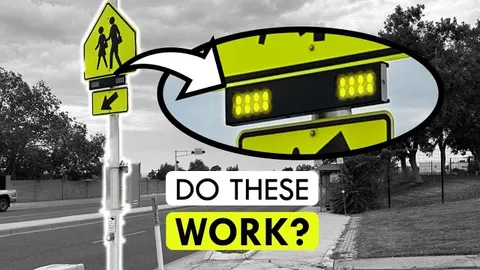
Ray Delahanty examines whether pedestrian crossing devices like RRFBs and HAWK signals actually work and how engineers decide when and where to install them. It covers the engineering decision process behind crosswalk requests, one of the Commonway System's named examples of changes residents ask for.
 Aligned
Can this "HAWK" STOP LIGHT make walking feel SAFE again?
 Road Guy Rob
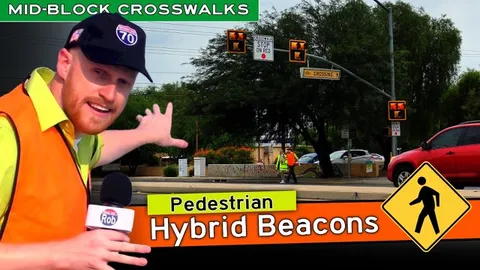
Rob explains why painted mid-block crosswalks and flashing yellow lights are so often ignored, then shows how the Pedestrian Hybrid Beacon (HAWK), which stays dark until a pedestrian calls it and then commands a full stop, reaches 97 to 99 percent driver compliance, with Tucson's warrant and equity criteria. It supports the Commonway System's Pedestrian Hybrid Beacon pattern directly, and shows why the Crosswalk, RRFB and Pedestrian Signal patterns rate different devices differently.
#Why this pattern exists
An uncontrolled crosswalk relies entirely on driver attentiveness and willingness to yield; an RRFB gives the crossing a strong, attention-getting visual cue exactly when a pedestrian or cyclist is present, without the cost and delay of a full traffic signal. This pattern exists to document this lighter-weight treatment and where it fits relative to a full signal or hybrid beacon.1
#Key considerations
- Most effective at midblock or lower-volume crossings where a full signal is not warranted but a marked crosswalk alone yields inconsistent results23
- User-activated designs (push button or passive detection) should be reliable and low-friction to use; a device people cannot easily activate will not get used
- Should be paired with adequate crosswalk marking and, where relevant, a refuge island rather than deployed as a standalone fix
#Related patterns
Crosswalk (ELM-CRW-08) (the crossing this pattern supports); Pedestrian Hybrid Beacon (ELM-PHB-18) (a stronger-control alternative for busier crossings); Traffic Signal (ELM-TFS-14) (the higher-control alternative this pattern is meant to avoid triggering)
#References
- Legal / regulatory MUTCD 11th Edition with Revision 1 (FHWA, December 2025; effective March 5, 2026). Formerly Interim Approval IA-21, now standardized.(opens in new tab)
- Evidence-based NCHRP Research Report 841 (2017), "Development of Crash Modification Factors for Uncontrolled Pedestrian Crossing Treatments," Transportation Research Board. Documents a crash modification factor of 0.53 for vehicle-pedestrian crashes.(opens in new tab)
- Evidence-based Fitzpatrick, K. et al., "Will You Stop for Me?," Report No. TTI-CTS-0010, Texas A&M Transportation Institute (2016). Driver-yielding research underlying its particular effectiveness at multilane crossings.(opens in new tab)