
Default (Standard Local Street)
LOC-DEF-01 Default (Standard Local Street)
#Illustration
Callouts
- (Physical) Sidewalk sized for comfortable two-way pedestrian travel.
- (Physical) Planting/furnishing zone buffering pedestrians from the travel lane.
- (Physical) Travel lane narrowed to self-enforce 20 mph.2
Related Media
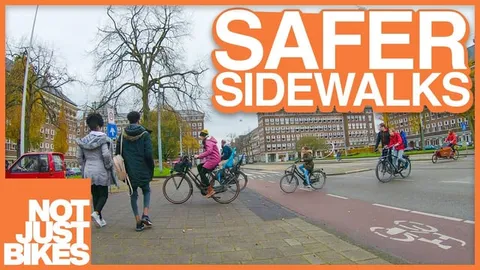 Aligned
The Dutch Solution for Safer Sidewalks - Continuous Sidewalks
 Not Just Bikes
Shows the same sidewalk-continuity concept behind Continuous Sidewalk / Raised Junction in practice: the roadway rises to meet the sidewalk at a crossing, rather than the sidewalk dropping to meet the road, so geometry itself signals the priority shift.
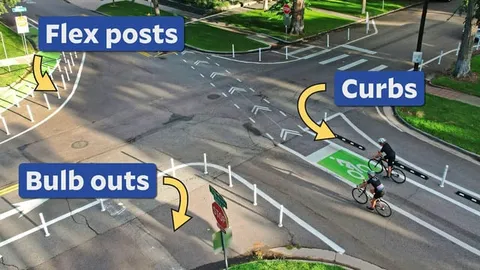 Aligned
Are Streets Too Complicated Now?
 City Beautiful
Asks whether today's proliferation of lines, signals, and lane types on streets is overcomplication or a needed response to modern demands, a question that runs directly through CS's Element-scale catalog and the density-tiered Corridor retrofit paths this video is tagged to.
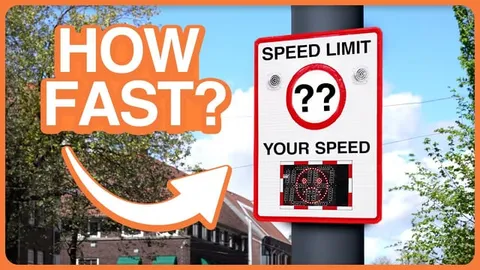 Aligned
What is the "Correct" Speed Limit?
Not Just BikesMakes the physics and data case for 30 km/h (roughly 20 mph) as the safe default urban speed, the same logic behind CS's own Local street speed cap.
#Where this pattern applies
Typical at: Suburban Compact Urban Core
Rural is an edge case, not the norm. Farm and rural-residential contexts more often produce a Rural Collector / Farm-to-Market Road pattern instead, since a genuinely Local-scale street needs enough nearby development to serve. Undeveloped contexts are unlikely to carry a Local street at all, for the same reason.
#Speed and modal hierarchy
Design speed & speed limit
Modal hierarchy
#Relationship to other Local Typologies
This entry is the reference point, not one option among equals. Reading the other eleven Local Typologies as departures from this baseline makes the whole set easier to hold in mind:
- Access-pattern departures: Alley, Cul-de-sac, Frontage / Service Road
- Land-use departures: Main Street
- Traffic-model departures: Living Street / Woonerf, Yield Street
- Temporary or event-based departures: Festival Street, School Street
- Full-time single-mode departures: Pedestrian-only Street / Plaza, Local Transit, Bicycle Boulevard / Neighborhood Greenway
#Where a Local street meets a bigger street
The default intersection treatment where this pattern meets a Collector is a Continuous Sidewalk / Raised Junction: the sidewalk and bike path stay uninterrupted, and the roadway ramps up to meet them rather than the reverse.
#Design notes
This entry is the standard against which every other Local Typology is defined as an override. A Typology only departs from the base modal order when its entire reason for existing is a specific mode.
#Related patterns
Continuous Sidewalk / Raised Junction (INT-CSJ-06) (this pattern's own default intersection treatment where it meets a Collector), Default (Standard Collector) (COL-DEF-01) (the equivalent baseline one Functional Classification up)
#References
- Legal / regulatory FHWA, "Self-Enforcing Roadways: A Guidance Report," FHWA-HRT-17-098, 2018.(opens in new tab)
- Precedent-based National Association of City Transportation Officials, Urban Street Design Guide, "Street Design Principles: Lane Width."(opens in new tab)