
Green Pavement / Conflict Marking
ELM-GPM-38 Green Pavement / Conflict Marking
Related Media
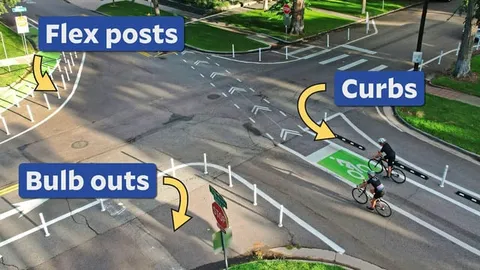 Aligned
Are Streets Too Complicated Now?
 City Beautiful
Asks whether today's proliferation of lines, signals, and lane types on streets is overcomplication or a needed response to modern demands, a question that runs directly through CS's Element-scale catalog and the density-tiered Corridor retrofit paths this video is tagged to.
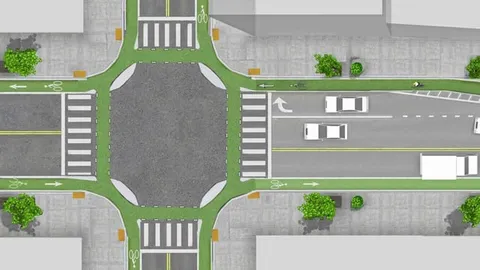 Aligned
Dutch-style intersection design: bike-friendly
 BicycleDutch
Shows the protected-intersection design vocabulary, continuous cycle tracks, corner refuge islands, separated signal phasing, that underpins CS's Protected Intersection pattern and the Corridor retrofit paths built around it.
#Why this pattern exists
At points where a bike facility’s path crosses or intersects with vehicle movement, a merging lane, a turn pocket, an intersection approach, the normal continuity of the bike facility’s visual cue breaks down; colored pavement restores visibility of the bike route through that conflict zone specifically. This pattern exists to document where and how this treatment should be applied.1
#Key considerations
- Should be reserved for genuine conflict points rather than applied continuously along a facility; overuse dilutes its attention-getting value
- Color and material should meet reflectivity and durability standards so the treatment remains visible and functional over time and weather exposure
- Most effective when paired with clear lane markings and signage rather than deployed as a standalone fix for an unclear conflict area
#Related patterns
Protected Bike Lane/Cycle Track (ELM-PBL-37), Buffered Bike Lane (ELM-BBL-35), Conventional Bike Lane (ELM-CBL-34) (the facilities this pattern supports at conflict points); Bike Box (ELM-BKB-42) (a related conflict-point treatment at intersections)