
Curb Extension
ELM-CBE-02 Curb Extension
Related Media
 Aligned
Are Streets Too Complicated Now?
 City Beautiful
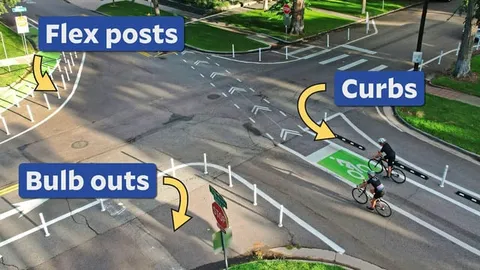
Asks whether today's proliferation of lines, signals, and lane types on streets is overcomplication or a needed response to modern demands, a question that runs directly through CS's Element-scale catalog and the density-tiered Corridor retrofit paths this video is tagged to.
 Aligned
Dutch-style intersection design: bike-friendly
 BicycleDutch
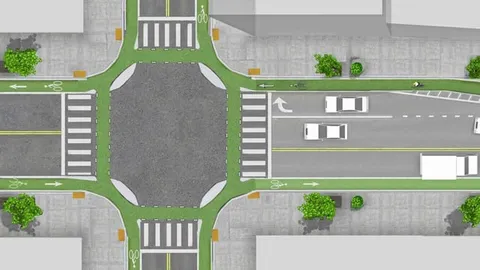
Shows the protected-intersection design vocabulary, continuous cycle tracks, corner refuge islands, separated signal phasing, that underpins CS's Protected Intersection pattern and the Corridor retrofit paths built around it.
 Aligned
This is the key to safer streets
 Streetcraft
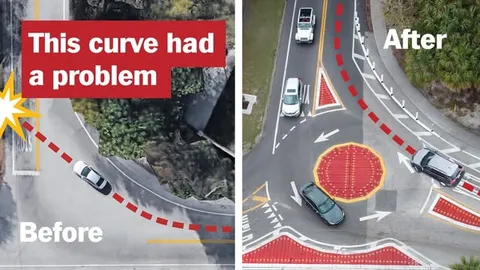
A full traffic-calming toolkit walkthrough, plastic mini-roundabouts, curb extensions, chicanes, the speed bump/hump/cushion/table family, and a Cincinnati road-diet case study with dramatic before/after crash data.
#Why this pattern exists
Narrowing the effective roadway width at a specific point shortens pedestrian crossing distance, slows turning and through vehicles, and can reclaim space for other uses (a bus stop, plantings, a parklet), addressing several distinct problems (crossing safety, traffic calming, space reclamation) with one flexible physical treatment.1
#Key considerations
- Form should match purpose: a bus bulb needs a different length and clearance than a corner pinchpoint or a mid-block chicane2
- Drainage design at the extension point needs attention, since it interrupts the normal curb and gutter line
- Sightlines for both drivers and pedestrians should be checked at the extension, especially near a crossing, since the extension changes sightline geometry
#Related patterns
Curb (ELM-CRB-01), Crosswalk (ELM-CRW-08) (typical pairing at a crossing); Plaza/Parklet (FAC-PLZ-07) (Facility pattern this often anchors); Transit Boarding Island (ELM-TBI-41) (a related but distinct treatment for transit stops); Modal Filter / Point Closure (ELM-MFP-44) (an alternative geometry for narrowing or partially closing a street), Median Island (ELM-MDI-45) (a center-of-roadway rather than lateral narrowing approach)
#References
- Precedent-based NACTO Urban Street Design Guide, "Curb Extensions." Crossing-distance reduction and sizing guidance (length at least the crosswalk width, 1-2 ft narrower than the parking lane).(opens in new tab)
- Evidence-based Federal Highway Administration, "Install Curb Extensions at the Crosswalk" (Uncontrolled Pedestrian Crossing Treatment sheet). Identifies crash history, vehicle/pedestrian conflict, and speeding as the conditions this treatment addresses.(opens in new tab)